

Why Tech Workers Are Panic-Selling $2M Homes (And Why That’s a Huge Mistake)
A tech engineer just sold his $2 million home.
He hasn’t been laid off.
His company hasn’t announced layoffs.
But he’s terrified. So he sold.
Now he’s paying $4,500/month in rent. He just locked in a $260,000-$280,000 loss. And he’s costing himself $113,760 per year in lost rental income.
All because he panicked.
This is what happens when people don’t understand market cycles. They react. They lose money. They regret it later.
Key Takeaway
Tech layoffs and a slower real estate market are making some Seattle homeowners panic-sell expensive homes before they actually need to. But selling during a fear-driven market can lock in large transaction losses, eliminate future rental income, and force owners into high monthly rent payments. For homeowners who are not facing an immediate life event, holding the property and renting it out may be the smarter long-term financial move.
The Tech Engineer's Fear (And Why It's Costing Him $568,800)
Here’s what he told the real estate agent:
“If I get laid off, I can’t pay the $12,000 mortgage. The market’s going down. I need to sell now while I can still get something for it.”
Sounds reasonable, right?
Wrong.
Here’s what actually happened:
What He Did:
- Sold his $2M home
- Lost $260K-$280K in transaction costs
- Rented an apartment for $4,500/month
- Thought he reduced his risk
What Actually Happened:
- Locked in a $260K-$280K loss immediately
- Now paying $54,000/year in rent
- Lost $59,760/year in potential rental income
- $113,760 worse off per year
- $568,800 worse off over 5 years
He made a massive financial decision based on a fear that never happened.
Not sure if your Seattle rental still makes sense as a long-term investment?
A rental market analysis can help you compare current rent, vacancy risk, local demand, and property performance before you decide whether to hold, sell, or professionalize management.
Howard Marks Called This 50 Years Ago
Howard Marks, founder of Oaktree Capital, wrote a book called “Mastering the Market Cycle.”
His insight: The best investors understand cycles. Everyone else panics.
Marks identified five stages of every market cycle:
Stage 1: Recovery – Prices rising, sentiment improving. Smart investors buy.
Stage 2: Expansion – Market accelerating, prices rising fast. Investors keep buying.
Stage 3: Peak/Euphoria – Market at highest point, everyone thinks it’ll go up forever. Smart investors sell aggressively.
Stage 4: Contraction – Market declining, prices falling, sentiment shifting negative. Panic begins.
Stage 5: Panic/Trough – Market at lowest point, everyone thinks it’ll go down forever. Smart investors buy aggressively.
The key insight: The best time to sell is Stage 3 (when everyone’s euphoric). The worst time to sell is Stage 4-5 (when everyone’s panicking).
Right now? We’re in Stage 4-5.
The tech engineer is selling at the worst possible time.
Where Are We in the Cycle? (The Real Estate Market in June 2026)
June 2025 (Stage 3: Peak/Euphoria)
- Homes selling in 18 days
- 35% selling above asking price
- Bidding wars everywhere
- Everyone saying “real estate always goes up”
June 2026 (Stage 4-5: Contraction/Panic)
- Homes taking 38 days to sell (+73%)
- Only 5% selling above asking price (-86%)
- 1,300 more homes on market (+62%)
- Everyone saying “the market’s collapsing”
The Shift:
- Inventory up 62%
- Days on market up 73%
- Price cuts up 175%
- Homes above ask down 86%
This is Stage 4-5. This is panic. This is the worst time to sell.
If your rental is sitting longer, attracting fewer inquiries, or producing weaker cash flow than expected, the problem may not be the property itself. It may be pricing, market timing, condition, or management strategy.
Get a rental market analysis and see how your property compares in today’s Seattle rental market.
The Tech Layoff Panic Is Real (But Overblown)
Let’s talk about the real fear: Tech layoffs.
The Layoff Timeline:
- 2024: 100,000+ tech workers laid off
- 2025: Another 50,000+ laid off
- 2026: Layoffs continuing but slowing
The Reality:
- Tech sector: 5+ million workers
- Laid off: ~150,000 over 2 years
- That’s 3% of the tech workforce
- 97% still employed
But the fear is real. The anxiety is real. The news is full of layoff stories.
So people panic. They sell. They make emotional decisions.
The tech engineer is one of them.
The Cycle Across Industries (Where We Are Now)
Tech Industry Cycle:
- 2015-2021: Boom (Stage 1-3)
- 2022-2023: Peak (Stage 3)
- 2024-2026: Contraction (Stage 4-5)
- 2027+: Recovery (Stage 5-1)
Real Estate Cycle:
- 2015-2021: Recovery (Stage 1-2)
- 2020-2023: Boom (Stage 2-3)
- 2024-2026: Contraction (Stage 4-5)
- 2027+: Recovery (Stage 5-1)
Rental Market Cycle:
- 2015-2023: Growth (Stage 1-3)
- 2024-2026: Slowdown (Stage 4)
- 2027+: Stabilization (Stage 4-5)
The Intersection Right Now:Tech is panicking + Real estate is contracting + Rentals are stable = Perfect storm of panic selling.
People like the tech engineer are flooding the market. Prices are declining. Inventory is building.
This is exactly when smart investors hold. Or buy.
Before you decide to keep, sell, or hand off your rental, make sure the numbers are clear.
A rental market analysis gives you a property-level look at rent potential, current market conditions, and the next best step for your Seattle rental.
The Math: Selling Now vs. Holding and Renting
Let’s be specific about the numbers.
Scenario: $2M Home in Seattle
Option 1: Sell Now (Stage 4-5)
- Sale price: $2,000,000
- Commission (5.5%): -$110,000
- Closing costs (2%): -$40,000
- Total costs: -$150,000
- Net proceeds: $1,850,000
- Plus: You have $1.85M in cash
- Minus: You’re paying $54,000/year in rent
- 5-year cost: $270,000 in rent
- Total after 5 years: $1,580,000
Option 2: Hold and Rent (Stage 4-5)
- Keep the home
- Rent it for $10,000/month (market rate for $2M home)
- Annual gross rent: $120,000
- Annual expenses: -$40,000 (management, maintenance, taxes, insurance)
- Annual net profit: $80,000
- 5-year profit: $400,000
- Plus: Home appreciation (assume 2% annually): $208,000
- Plus: Mortgage paydown: $60,000+
- Total after 5 years: $668,000+ in profit
The Comparison:
- Selling now: $1,580,000
- Holding and renting: $2,668,000+
- Difference: $1,088,000
By holding and renting, he’s ahead by over $1 million in 5 years.
Why This Happens: The Psychology of Panic Selling
People panic for a reason. The fear is real.
But fear is a terrible decision-maker.
What Panic Sellers Think:
- “The market’s going down”
- “I might lose my job”
- “I need to reduce risk”
- “I should sell before it gets worse”
What Actually Happens:
- They lock in losses
- They miss out on recovery
- They pay transaction costs
- They pay rent instead of building equity
The Cycle Repeats:
- Stage 3 (Peak): People get greedy, buy at the top
- Stage 4-5 (Panic): People get scared, sell at the bottom
- Stage 1-2 (Recovery): People who held are rich, people who sold are poor
Howard Marks calls this “the most important thing”: Understanding cycles prevents you from making emotional decisions.
What Should You Actually Do?
If You MUST Sell (Real Life Event):
- Relocating for work
- Retiring and moving
- Genuine emergency
- Then sell. Accept the market. Move on.
If You CAN Hold (No Life Event):
- Don’t sell just because you’re scared
- Don’t sell because the news is scary
- Don’t sell because you might get laid off
Instead: Rent it out.
Here’s why:
The Numbers Are Clear:
- Selling now: Lose $150,000-$280,000 in costs
- Renting out: Earn $80,000/year profit
- Over 5 years: Renting ahead by $1,088,000
The Psychology Is Clear:
- Selling now: Emotional decision based on fear
- Renting out: Rational decision based on cycles
- Smart investors: Hold through cycles
Ready to Price Your Rental Correctly?
Calculate Your Rental Potential
Use our True Cost Calculator to understand your property’s value and rental potential. Input your address and see:
- What your property is worth today
- What you’d net if you sold
- What you’d earn if you kept it as a rental
- How your neighborhood compares
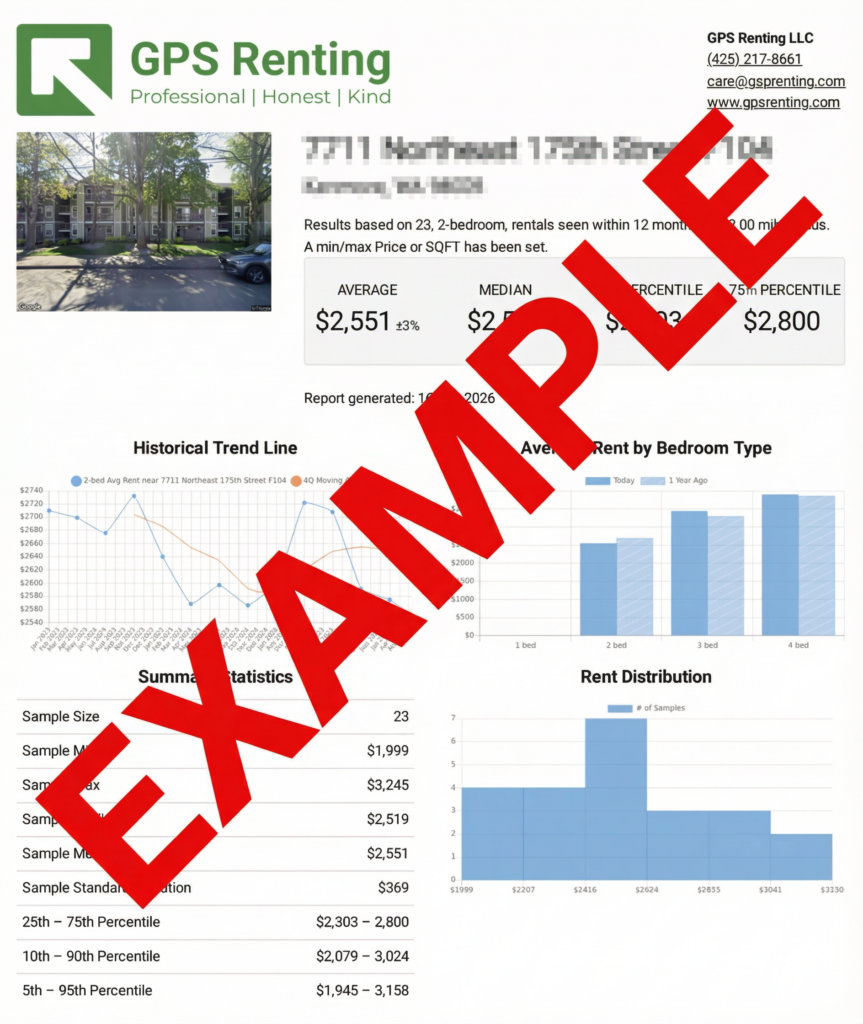
How to Rent Your $2M Home (And Earn $80K/Year)
If you decide to hold and rent, here’s the process:
Step 1: Calculate Your Rental Potential
Use our True Cost Calculator to see exactly what your home could rent for.
For a $2M Seattle home:
- Market rent: $10,000-$12,000/month
- Annual gross: $120,000-$144,000
- Annual expenses: $40,000-$50,000
- Annual profit: $70,000-$94,000
Calculate Your Rental Potential →
Step 2: Prepare the Property
Fresh paint, professional photos, good condition. Make it rentable.
Step 3: Price at Market Rate
Don’t underprice. Price where comparable homes are renting.
Step 4: Market Professionally
List on multiple platforms. Use video. Be visible.
Step 5: Screen Tenants
Income verification, credit check, references, background check. Find quality tenants.
Step 6: Consider Professional Management
If you don’t want to manage it, GPS Renting handles everything:
- Tenant screening and placement
- Rent collection
- Maintenance coordination
- Legal compliance (EHB 1217, etc.)
- Profit optimization
Need Help Navigating This Market?
Schedule a Consultation
Market shifts can make pricing, leasing, and tenant placement more complex than expected.
If you’d rather focus on your investment while professionals handle pricing strategy, marketing, and tenant screening, we’re here to help.

Haobang Lu
Business Development Manager
The Bottom Line: Don't Panic Sell
The tech engineer’s story is a cautionary tale.
He hasn’t been laid off. His company hasn’t announced layoffs. But he’s selling his $2M house anyway.
He’s making a $260K-$280K decision based on fear.
He’s costing himself $113,760 per year.
He’s $1,088,000 worse off over 5 years.
All because he panicked.
Howard Marks spent 50 years studying markets. His conclusion: The best investors understand cycles. They don’t panic. They don’t make emotional decisions.
Right now, we’re in Stage 4-5 (Contraction/Panic).
This is the worst time to sell.
This is the best time to hold and rent.
Don’t be like the tech engineer.
Sources
- City of Seattle Renting in Seattle portal
- Seattle Rental Registration and Inspection Ordinance
- Seattle First-in-Time rules
- Seattle Housing Cost Increases
- Zillow Rental Manager Seattle Market Trends
- NWMLS Market Snapshot
- IRS Publication 523
- IRS Publication 527
- Washington Department of Revenue Capital Gains Tax