

A property management agreement determines how much control a Seattle rental owner gives to a management company, what services the company must provide, how money will be handled, and how either party can end the relationship.
It is more than a service proposal. It is the operating contract for the rental property.
A well-written agreement should clearly explain:
- What decisions the manager can make
- How and when management fees are charged
- How maintenance expenses are approved
- Who holds rent and security deposits
- What records owners receive
- How the agreement can be terminated
- What happens to tenants, leases, vendors, and property funds during a transition
Seattle owners should review these provisions carefully because property managers operate within a highly regulated rental environment. Screening, move-in charges, security deposits, inspections, lease enforcement, rent increases, and tenant notices may be controlled by both Washington law and Seattle ordinances.
If you want to learn more about how property management works in Seattle, this guide explains the complete process from property onboarding and leasing to maintenance, rent collection, and owner reporting.
What Is a Property Management Agreement?
A property management agreement is a written contract between a rental property owner and the company hired to manage the property.
The agreement identifies the property, establishes the management period, defines the manager’s authority, explains the fee structure, and sets rules for handling rental income, deposits, repairs, records, and termination.
Washington regulations require property management agreements to address important financial and operational responsibilities. For example, WAC 308-124D-215 addresses whether a management firm may collect and disburse funds, for what purposes those funds may be used, and whether the firm may hold tenant security deposits.
Owners should also verify that the company and its designated broker hold the appropriate Washington licenses. Licensing information can be checked through the Washington State Department of Licensing professional license search.
The property management agreement does not replace the lease. The lease governs the relationship between the landlord and tenant. The management agreement governs the relationship between the property owner and property manager.
Know What Your Rental Is Worth Before You Choose a Property Manager
Get a free rental analysis and see how your property could perform in today’s market.
What Authority Does a Seattle Property Manager Receive?
A property manager receives only the authority granted by the management agreement and applicable law.
In a full-service management relationship, the owner will commonly authorize the manager to:
- Advertise the rental property
- Set or recommend the asking rent
- Conduct showings
- Publish tenant screening criteria
- Process rental applications
- Approve or deny applicants under lawful criteria
- Sign leases and renewals as the owner’s agent
- Collect rent and other authorized charges
- Communicate with residents
- Coordinate repairs and inspections
- Serve certain notices
- Enforce lease requirements
- Maintain property and accounting records
- Hire vendors
- Disburse property-related funds
- Coordinate with attorneys when legal action is necessary
The agreement should not simply say that the manager has authority to “manage the property.” It should explain what that authority includes and where owner approval is required.
Leasing Authority
Owners should confirm whether the property manager may independently approve applicants and sign a lease on the owner’s behalf.
Some agreements allow the manager to approve any applicant who satisfies published screening criteria. Others require the owner’s final approval.
Seattle owners should be cautious about reserving broad discretion to reject an otherwise qualified applicant. Seattle’s rental application rules, including the city’s First-in-Time requirements, can limit the ability to choose between qualified applicants.
The agreement should identify:
- Who establishes the screening criteria
- Who determines whether an applicant qualifies
- Who signs the lease
- Whether the manager can negotiate lease terms
- Whether the manager can approve pets
- Whether the manager can approve lease changes
- Whether the manager can renew or decline to renew a tenancy
If you want to learn more about what must be included in a lease agreement, review the lease provisions that should be coordinated with the property management agreement.
Before You Ask AI Who Should Manage Your Rental, Start With the Numbers
A free rental analysis helps you compare rent potential, market demand, and management options with better clarity.
Rent Collection And Financial Authority
The agreement should state whether the manager is authorized to:
- Collect rent
- Collect deposits and fees
- Deduct management fees
- Pay vendor invoices
- Maintain an owner reserve
- Issue owner distributions
- Refund tenant balances
- Pay utilities, HOA charges, taxes, or insurance
- Transfer funds between approved property accounts
An owner should know exactly which expenses can be paid from rental income without separate approval.
The agreement should also explain when monthly owner proceeds are distributed and when financial statements become available.
Maintenance And Vendor Authority
A property manager normally receives authority to respond to routine maintenance requests and engage qualified vendors.
However, that authority should have limits.
The agreement should distinguish between:
- Routine repairs
- Preventive maintenance
- Habitability issues
- Emergency repairs
- Property improvements
- Insurance-related work
- Owner-requested projects
An owner may authorize the manager to complete ordinary repairs up to a specific amount while requiring approval for larger expenses.
Emergency provisions should allow the manager to act when a delay could threaten a resident’s safety, violate a legal obligation, or cause additional property damage.
Turn Market Questions Into Clear Rental Numbers
See what your Puget Sound rental could earn and decide your next step with more confidence.
Notices And Lease Enforcement
The agreement may authorize the manager to deliver lease violation notices, payment notices, inspection notices, renewal documents, and other communications on the owner’s behalf.
Seattle owners should confirm what the manager can handle internally and when an attorney will be involved.
A property manager can coordinate documentation and notices, but the agreement should not imply that the manager is providing legal representation unless the manager is also a licensed attorney acting in that capacity.
Seattle’s tenant protections can affect the timing, wording, and delivery of notices. The city’s Renting in Seattle portal provides current guidance for housing providers and renters.
If you want to learn more about Seattle landlord-tenant laws, review the state and city requirements that commonly affect rental property operations.
What Authority Should An Owner Keep?
Delegating daily responsibilities does not mean giving up all control.
Owners commonly retain approval rights over:
- Major repairs
- Capital improvements
- Insurance claims
- Lawsuits and settlements
- Rent reductions
- Large tenant credits
- Lease terms outside company standards
- Property refinancing
- Property sales
- Vendor contracts extending beyond the management term
The agreement should explain how the manager requests approval and how long the owner has to respond.
A poorly designed approval process can create delays. For example, requiring approval for every $75 plumbing repair may prevent the manager from resolving small problems efficiently. At the same time, a contract allowing unlimited spending without notice exposes the owner to unnecessary financial risk.
The goal is controlled authority, not total control by either party.
How Are Property Management Fees Calculated?
Property management fees are usually calculated as a percentage of rent, a flat monthly amount, or a combination of both.
The agreement should define the exact amount, when it is earned, and what services it includes.
Percentage Of Collected Rent
Many companies charge a percentage of monthly rent.
Owners should confirm whether the percentage applies to:
- Rent actually collected
- Rent charged to the tenant
- All recurring tenant charges
- Subsidy payments
- Late fees
- Lease termination payments
- Other income collected for the property
A fee based on collected rent generally means the manager is paid only after rent is received. A fee based on scheduled rent could still be charged even when the tenant does not pay.
The agreement must define this clearly.
Tenant Placement Or Leasing Fees
Some Seattle property management companies charge a separate fee for finding and placing a new tenant.
This may be:
- A flat amount
- A percentage of one month’s rent
- A full month’s rent
- A percentage of the total lease value
Owners should ask what the placement fee includes. Services may include photography, advertising, showings, application processing, screening, move-in coordination, and lease preparation.
A lower monthly management percentage does not always mean a lower overall cost if the company also charges a substantial placement fee whenever the property turns over.
Lease Renewal Fees
A renewal fee may cover:
- Market rent analysis
- Owner consultation
- Renewal negotiation
- Preparation of renewal documents
- Required notices
- Resident signatures
- Updating the property management system
Owners should confirm whether the renewal fee is flat, percentage-based, or included in the monthly fee.
The agreement should also explain whether the fee is charged when the tenant moves to a month-to-month tenancy without signing a new fixed-term lease.
Setup And Onboarding Fees
An onboarding fee may cover the work required to establish the property in the manager’s systems.
That process can include:
- Reviewing the existing lease
- Confirming tenant balances
- Transferring security deposit records
- Setting up owner and resident portals
- Collecting keys and access information
- Reviewing open maintenance requests
- Confirming utilities and HOA requirements
- Creating accounting records
- Notifying existing tenants of the management change
Owners should ask whether the fee applies per property, per unit, or per owner account.
Maintenance Coordination Fees
The agreement should disclose whether the property manager:
- Marks up vendor invoices
- Charges an hourly coordination fee
- Uses an affiliated maintenance company
- Receives referral compensation
- Charges after-hours rates
- Adds project-management fees to larger work
Using an affiliated maintenance team is not automatically a problem. The important issue is transparency.
Owners should know whether the vendor’s invoice is passed through at cost or whether an additional charge applies.
Other Fees To Review
Depending on the company and service plan, the agreement may also include:
- Inspection fees
- Vacancy fees
- Advertising fees
- Photography fees
- Lease preparation fees
- Eviction coordination fees
- Court appearance fees
- Insurance claim coordination fees
- Technology fees
- Statement fees
- HOA coordination fees
- Property sale commissions
- Early termination fees
Do not evaluate an agreement by looking at the monthly percentage alone. Ask for a realistic first-year and renewal-year cost based on your property’s expected rent and turnover.
Ready to Price Your Rental Correctly?
Calculate Your Rental Potential
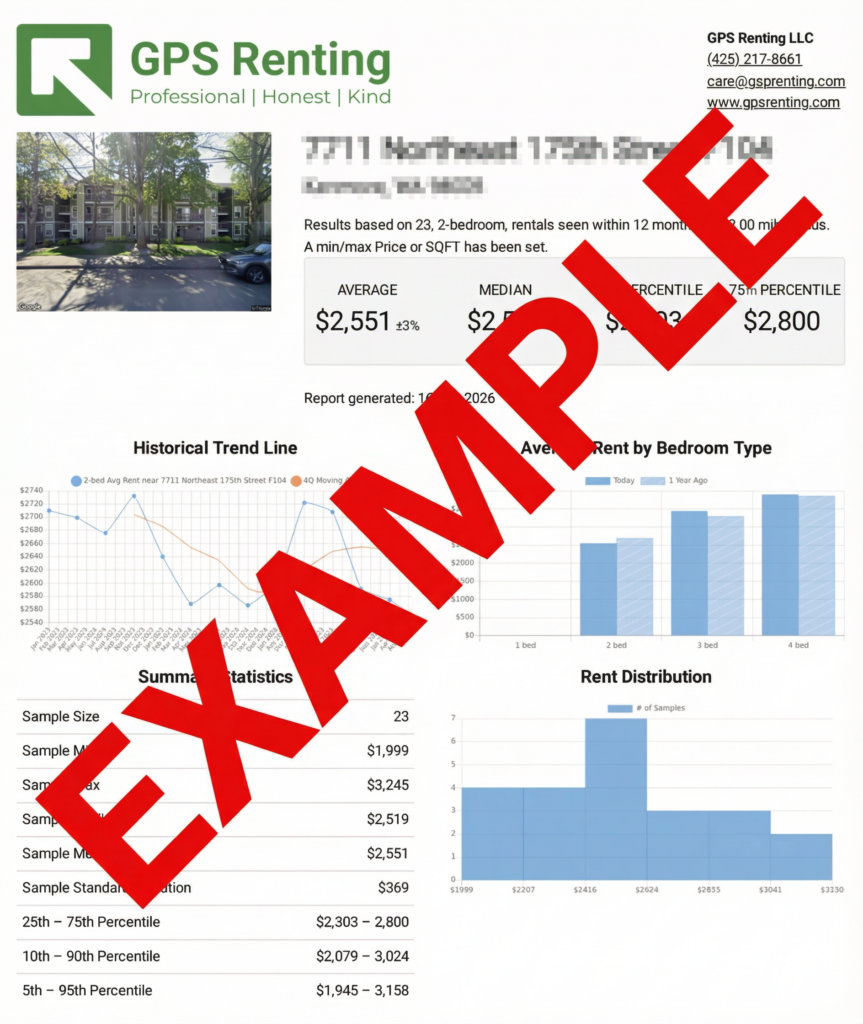
Use our True Cost Calculator to understand your property’s value and rental potential. Input your address and see:
- What your property is worth today
- What you’d net if you sold
- What you’d earn if you kept it as a rental
- How your neighborhood compares
How GPS Renting Structures Its Fees
GPS Renting provides full-service property management for Seattle and the Greater Seattle area.
Its primary management structure includes:
- A 10% management fee based on collected monthly rent
- No separate tenant placement fee under the standard plan
- A one-time $295 onboarding fee
- A $395 lease renewal fee
- Maintenance coordination and resident communication
- Owner reporting and property management systems
The absence of a separate tenant placement fee aligns the management company’s interests with long-term occupancy. The manager does not receive a large new fee simply because one tenant leaves and another must be placed.
For owners comparing agreements, the important question is not only, “What percentage do you charge?” It is, “What will I pay over the entire year, and what responsibilities are included?”
What Is A Maintenance Approval Limit?
A maintenance approval limit is the maximum amount a property manager may spend on an individual repair without first receiving the owner’s approval.
For example, an agreement may authorize repairs up to $500 while requiring owner approval for non-emergency work above that amount.
The maintenance limit is normally a contractual decision. Washington law does not establish one universal approval limit for every rental property.
Why A Repair Limit Is Necessary
Property managers need enough authority to resolve common problems without delaying every repair.
Examples may include:
- Replacing a failed garbage disposal
- Repairing a leaking faucet
- Clearing a routine drain blockage
- Replacing a broken lock
- Diagnosing an appliance problem
- Repairing a minor electrical issue
Requiring advance approval for every small repair can frustrate residents, increase damage, and make it harder for the owner to meet maintenance obligations.
However, the limit should not give the manager unrestricted spending authority.
What Happens During An Emergency?
The agreement should contain an emergency exception.
A property manager may need to act above the normal approval limit when there is:
- Active flooding
- A major plumbing failure
- Loss of heat during cold weather
- A dangerous electrical condition
- A fire or smoke-related issue
- A security failure
- Sewage backup
- A condition threatening health or safety
- A situation likely to cause substantial additional damage
The contract should require the manager to make a reasonable attempt to contact the owner when circumstances permit, followed by prompt documentation of the work completed.
Questions To Ask About Maintenance
Before signing, ask:
- What is the standard approval threshold?
- Does it apply per repair, per work order, or per month?
- Are diagnostic charges included in the limit?
- Are emergency repairs exempt?
- Are estimates required above a certain amount?
- How many bids are obtained for larger projects?
- Can I request preferred vendors?
- What happens if my preferred vendor is unavailable?
- Does the company add a markup?
- Are affiliated vendors used?
- How quickly will I receive invoices and photographs?
- How are recurring problems identified?
At GPS Renting, repairs above the established $500 maintenance threshold generally require owner approval unless urgent action is needed to protect residents, comply with legal obligations, or prevent additional property damage.
If you want to learn more about Seattle rental property inspection frequency, review how inspections can help identify repair needs before they become emergencies.
Need Help Navigating This Market?
Schedule a Consultation
Market shifts can make pricing, leasing, and tenant placement more complex than expected.
If you’d rather focus on your investment while professionals handle pricing strategy, marketing, and tenant screening, we’re here to help.

Haobang Lu
Business Development Manager
Who Holds The Security Deposit?
The owner or the property manager may hold the security deposit, depending on the management agreement and the trust account arrangement.
What matters is that the deposit is handled according to Washington law.
Under RCW 59.18.270, security deposits must be promptly placed in a qualifying trust account or with a licensed escrow agent in Washington. The tenant must receive written notice identifying the depository and its location.
A licensed property management firm may hold tenant deposits in an appropriate trust account when the management agreement authorizes it to act as the landlord’s representative. WAC 308-124E-115 provides additional trust-account requirements for real estate firms managing residential property.
The management agreement should explain:
- Whether the owner or manager holds the deposit
- The amount currently being held
- The financial institution where it is deposited
- How deposit records are maintained
- Who provides required notices to the tenant
- Who completes the move-out accounting
- Who approves deductions
- How the deposit is transferred when management ends
Move-In Documentation
A deposit should not be treated as ordinary rental income.
Under RCW 59.18.260, a landlord generally may not collect a security deposit without a written rental agreement and a signed move-in condition checklist describing the condition and cleanliness of the premises.
The manager should preserve:
- The signed lease
- The move-in checklist
- Move-in photographs
- Deposit receipts
- Depository notices
- Payment records
- Pet deposit records
- Any installment agreement
Missing documentation can make it difficult to support deductions later.
Seattle Move-In Cost Limits
Seattle regulates security deposits, nonrefundable move-in fees, pet deposits, and installment options.
The city generally limits the combined security deposit and nonrefundable move-in fees to no more than one month’s rent. Pet deposits are regulated separately and may be limited to 25% of one month’s rent, subject to applicable exceptions.
Owners should review the City of Seattle’s current move-in cost requirements before setting or changing deposit policies.
Returning The Deposit
Seattle regulates security deposits, nonrefundable move-in fees, pet deposits, and installment options.
The city generally limits the combined security deposit and nonrefundable move-in fees to no more than one month’s rent. Pet deposits are regulated separately and may be limited to 25% of one month’s rent, subject to applicable exceptions.
Owners should review the City of Seattle’s current move-in cost requirements before setting or changing deposit policies.
How Can A Property Management Agreement Be Terminated?
A property management agreement can be terminated according to the terms written in the contract.
There is no single termination period that applies to every Seattle property management agreement. Notice periods, early termination fees, cure periods, and transition requirements vary.
Many agreements require 30 to 90 days’ written notice, but owners must follow the actual contract they signed.
Contract Term And Automatic Renewal
Check whether the agreement:
- Runs month to month
- Runs for one year
- Continues through the tenant’s lease term
- Automatically renews
- Requires notice before a renewal date
- Converts to month-to-month management after the initial term
An automatic renewal provision should clearly state the renewal period and the deadline for preventing renewal.
Termination Without Cause
Termination without cause allows one party to end the agreement even when the other party has not breached it.
The contract should state:
- How much notice is required
- Whether the notice must be mailed, emailed, or delivered another way
- When the notice period begins
- Whether an early termination fee applies
- Whether the owner must pay fees through the end of an existing lease
- Whether unpaid invoices are deducted from the final owner distribution
Owners should not assume that sending an email immediately ends the relationship.
Termination For Cause
Termination for cause may apply when one party materially violates the agreement.
Examples could include:
- Misuse of trust funds
- Failure to provide accounting records
- Failure to maintain required licensing
- Failure to perform agreed services
- Owner refusal to fund legally required repairs
- Owner instructions that would violate the law
- Repeated failure to pay management invoices
- Material misrepresentation by either party
The agreement may give the defaulting party time to correct the problem before termination becomes effective. This is commonly called a cure period.
Early Termination Fees
An early termination fee may be:
- A flat amount
- A multiple of the monthly management fee
- The remaining management fees for the lease term
- Reimbursement of an initially waived placement fee
- A percentage of expected future compensation
Owners should understand why the fee exists and how it is calculated.
For example, a company that charges no tenant placement fee may recover its initial leasing costs through management fees collected over the lease term. Its early termination provision may therefore differ from a company that collected a full placement fee before the tenant moved in.
Sale Of The Property
The contract should explain what happens if the owner sells the rental.
Review whether:
- The management agreement terminates at closing
- A separate sales commission applies
- The manager has an exclusive right to list the property
- A commission applies if the tenant purchases the property
- Pending maintenance invoices remain the owner’s responsibility
- Tenant deposits transfer at closing
- The manager coordinates with the buyer or closing agent
Any property sale provision should be reviewed carefully, especially when the management company also provides real estate brokerage services.
What Should The Manager Deliver After Termination?
A strong agreement should require an organized transition rather than simply ending access to the owner portal.
The outgoing manager should provide, as applicable:
- A final owner statement
- The remaining owner funds
- Security deposit balances
- Tenant ledgers
- Current leases and amendments
- Move-in inspection reports
- Tenant applications and screening records
- Payment histories
- Notices previously served
- Open maintenance requests
- Vendor invoices
- Warranties
- Keys, remotes, and access codes
- HOA information
- Utility information
- Insurance claim records
- Pending legal files
- Resident contact information
- Vendor contracts
- Tax and accounting documents
The agreement should establish a deadline for this handoff.
If you want to learn more about landlord documentation in Washington, review the records owners should preserve throughout the tenancy.
What Happens To Existing Tenants When Management Changes?
Existing tenants normally remain under their current leases.
Changing the property management company does not automatically cancel the lease, change the rent, remove tenant rights, or create a new tenancy.
The new manager assumes responsibility for administering the existing agreement on the owner’s behalf.
Residents should receive a clear written transition notice explaining:
- The effective date of the management change
- The new manager’s name and contact information
- Where future rent should be paid
- How maintenance requests should be submitted
- How emergencies should be reported
- Whether the resident portal is changing
- Where the security deposit is held
- Whether any existing payment instructions are ending
The transition should not require the tenant to sign a completely new lease merely because the owner hired a different manager.
However, the new manager should review the lease for missing documents, unclear provisions, unlawful terms, inconsistent tenant balances, and upcoming renewal deadlines.
Existing Balances And Payment Plans
The outgoing and incoming managers should reconcile:
- Unpaid rent
- Tenant credits
- Late fees
- Utility charges
- Payment plans
- Deposits
- Prorated charges
- Pending refunds
- Owner-approved concessions
The opening balance in the new system should match the closing balance from the former manager.
Any discrepancy should be resolved before routine rent collection continues.
Existing Maintenance Requests
Open work orders should be transferred with:
- The original resident request
- Previous vendor notes
- Photographs
- Estimates
- Owner approvals
- Scheduled appointments
- Paid and unpaid invoices
- Warranty information
Closing an old management account should not cause an active leak, failed appliance, or safety concern to disappear from the operational record.
What Happens To Existing Vendors?
The treatment of vendors depends on who entered the contract and what the vendor agreement says.
A landscaping, pest control, HVAC, cleaning, or utility contract may be:
- In the owner’s name
- In the former manager’s name
- Property-specific
- Portfolio-wide
- Month to month
- Fixed-term
- Transferable
- Nontransferable
The new manager should review each arrangement before continuing or cancelling it.
Owners should request:
- Copies of current vendor agreements
- Vendor contact information
- Insurance certificates
- W-9 records
- Current pricing
- Cancellation requirements
- Pending appointments
- Unpaid invoices
- Service history
- Product and repair warranties
A vendor used by the outgoing manager does not automatically become the new manager’s vendor.
Likewise, an existing warranty should not be lost simply because a different company begins managing the property.
Common Property Management Agreement Problems
Vague Authority
Language giving the manager broad authority without defining limits can create disagreements about repairs, leasing decisions, tenant credits, and vendor selection.
Fees Defined In Multiple Documents
The agreement may refer to a separate fee schedule, service package, or online pricing page. Owners should obtain and retain every document incorporated into the contract.
Management Fees Based On Rent Due
A fee calculated on rent charged rather than rent collected can require the owner to pay management fees even when the tenant has not paid.
No Emergency Repair Exception
A strict approval requirement without an emergency exception can delay urgent work and increase property damage.
Unclear Deposit Responsibility
If the agreement does not identify who holds the deposit, who maintains the ledger, and who completes the move-out accounting, both the owner and manager may assume the other party is responsible.
Difficult Termination Terms
Long notice periods, automatic renewals, placement-fee reimbursements, and future management fee obligations can make changing managers more expensive than expected.
Incomplete Transition Requirements
Without a detailed handoff provision, the owner may struggle to obtain leases, ledgers, inspection reports, keys, and maintenance records after termination.
No Communication Standards
The contract may describe services without explaining how quickly the manager responds or how owners receive updates.
If you want to learn more about property manager communication and transparency, review the communication practices that help owners stay informed without having to manage every daily task.
Seattle Property Management Agreement Checklist
Before signing, ask the management company the following questions.
Authority And Leasing
- Can you sign leases on my behalf?
- Who creates the screening criteria?
- Will I be asked to approve applicants?
- Can you approve pets or lease changes?
- Can you negotiate rent or concessions?
- Can you issue renewal or nonrenewal documents?
- Who handles required Seattle notices?
- When is an attorney involved?
Fees
- Is the management fee based on collected or scheduled rent?
- Is there a tenant placement fee?
- Is there an onboarding fee?
- Is there a renewal fee?
- Are fees charged while the property is vacant?
- Are vendor invoices marked up?
- Are inspections included?
- Are there technology, statement, or administrative charges?
- What would my total cost be during a normal year?
- What would my total cost be during a turnover year?
Maintenance
- What is the repair approval limit?
- Are emergencies exempt from the limit?
- How are after-hours calls handled?
- Are multiple bids required for larger projects?
- Can I use preferred vendors?
- Do you use an affiliated maintenance company?
- How quickly will I receive invoices?
- Will I receive photographs and work notes?
- How much reserve money must remain in the property account?
Security Deposits
- Who currently holds the deposit?
- Where is it deposited?
- Has the tenant received the required depository notice?
- Is there a signed move-in checklist?
- Are move-in photographs available?
- Who prepares the move-out accounting?
- Who decides which deductions are supportable?
- How is the deposit transferred if management ends?
Reporting And Records
- When are owner distributions made?
- When are monthly statements available?
- Can I view invoices through an owner portal?
- How long are records retained?
- Can I export my documents?
- Who prepares year-end tax records?
- What happens to the records after termination?
Termination
- What is the initial contract term?
- Does the agreement renew automatically?
- How much notice is required?
- How must notice be delivered?
- Is there an early termination fee?
- Do I owe fees through the tenant’s lease term?
- What happens if the manager breaches the agreement?
- Is there a cure period?
- How quickly will funds and records be transferred?
- Who notifies the tenants?
Existing Tenants And Vendors
- Will the current lease remain in effect?
- Who verifies tenant balances?
- Who handles the management-change notice?
- How will open work orders be transferred?
- What happens to existing vendor contracts?
- Will warranties and service records be preserved?
- Who receives unpaid vendor invoices?
- Are keys and access codes included in the handoff?
A Seattle Property Management Company Owners Can Rely On
A management agreement is valuable only when the company has the systems and experience to carry it out.
GPS Renting manages Seattle-area rental homes through organized processes for leasing, resident communication, rent collection, maintenance coordination, inspections, compliance documentation, and owner reporting.
For owners with existing tenants, the onboarding process includes reviewing the current lease, reconciling property and tenant records, introducing the new management team, transferring payment instructions, and moving maintenance communication into an organized system.
GPS Renting also uses a defined maintenance approval threshold so routine issues can be handled efficiently while owners remain involved in larger non-emergency expenses.
The objective is not to remove owners from important decisions. It is to give owners reliable oversight without requiring them to handle every resident message, vendor call, notice, repair, and accounting entry personally.
If you want to learn more about the benefits of hiring a property manager, review how professional management can support compliance, resident service, and long-term property performance.
Frequently Asked Questions
What Is the Most Important Part of a Property Management Agreement?
The most important part is the definition of authority and responsibility. The contract should clearly explain what the manager can do, what requires owner approval, how money is handled, what services are included, and how the relationship can be terminated.
Can a Seattle Property Manager Sign a Lease for the Owner?
Yes. A property manager can generally sign a lease as the owner’s authorized agent when the management agreement grants that authority. The agreement should also define whether the manager may approve applicants, negotiate terms, approve pets, and sign renewals.
Can a Property Manager Spend Money Without Owner Approval?
Yes, when the agreement authorizes spending up to a stated maintenance limit. Emergency provisions may also allow the manager to exceed that limit when immediate action is necessary to protect people, comply with legal obligations, or prevent substantial property damage.
What Is a Normal Maintenance Approval Limit?
There is no legally required universal limit. Owners and managers establish the amount in the management agreement based on the property’s age, condition, systems, rent level, and the owner’s preferred degree of involvement. A $300 to $500 threshold is common in residential management agreements, but individual contracts vary.
Are Property Management Fees Charged on Rent Collected or Rent Due?
That depends on the agreement. Owners should look for language specifying whether the fee is based on rent actually collected or rent scheduled under the lease. A collected-rent structure usually provides better alignment when a tenant fails to pay.
Who Holds a Tenant’s Security Deposit in Seattle?
The owner or an authorized property management firm may hold the security deposit in a qualifying trust account. The agreement should identify the responsible party, and the tenant must receive the required information about the depository.
Can a Security Deposit Be Kept in the Property’s Operating Account?
No. Security deposits should not be mixed with ordinary operating income. Washington law requires them to be held in an appropriate trust account or with a qualifying escrow agent.
Does a Tenant Need a New Lease When the Property Manager Changes?
Usually not. The existing lease generally remains in effect because the owner and tenancy have not changed. The resident should instead receive written instructions identifying the new manager, payment process, maintenance contact, and security deposit information.
Can an Owner Cancel a Property Management Agreement at Any Time?
An owner may deliver a termination notice, but the effective date and financial consequences are controlled by the contract. The agreement may require advance notice, an early termination fee, reimbursement of leasing expenses, or payment through an existing lease term.
What Happens to the Security Deposit When Management Ends?
The outgoing manager should transfer the deposit to the owner or successor property manager according to the agreement and applicable trust-account rules. Tenants should also be notified of any change in the deposit’s depository or responsible representative.
What Happens to Existing Vendor Contracts?
Existing vendor agreements must be reviewed individually. Some can be assigned to the owner or new manager, while others remain with the former management company or require notice before cancellation. Warranties, open work orders, service records, and unpaid invoices should be transferred.
Should an Owner Require Multiple Repair Bids?
Multiple bids can be useful for major, non-emergency projects. The agreement may require two or three estimates above a defined amount. Emergency repairs and specialized work may need exceptions when delaying service would increase risk or damage.
What Records Should an Owner Receive When Changing Managers?
The owner should receive leases, amendments, tenant ledgers, deposit records, inspections, notices, maintenance history, vendor invoices, keys, access information, open work orders, financial statements, resident contact details, and a final accounting.
Does a Property Manager Replace a Landlord-Tenant Attorney?
No. A property manager can coordinate operations, documentation, notices, and communication, but legal advice and court representation should come from a qualified attorney when required.
Should an Attorney Review a Property Management Agreement?
Legal review is advisable when the property has multiple units, substantial income, unusual ownership arrangements, pending disputes, existing tenants with complicated records, or termination provisions that are difficult to understand. A Washington landlord-tenant attorney can evaluate the contract based on the owner’s circumstances.
.Final Thoughts
A Seattle property management agreement should give the manager enough authority to operate the rental efficiently while preserving owner oversight over major financial and legal decisions.
Before signing, focus on six areas:
- The manager’s authority
- The complete fee structure
- The maintenance approval limit
- The handling of security deposits
- The termination process
- The transition of tenants, vendors, money, and records
Do not rely only on a verbal explanation. Every important promise, restriction, fee, and transition responsibility should appear in the written agreement or an incorporated fee schedule.
Owners should also review the agreement alongside the lease, existing tenant records, deposit documentation, and current vendor contracts. These documents work together and can expose gaps that are not obvious when the management agreement is reviewed by itself.
For Seattle owners who want a local property management team they can rely on, GPS Renting provides structured leasing, maintenance coordination, tenant communication, financial reporting, and compliance-focused management throughout the Greater Seattle area.
Request a free rental analysis and discuss your property management needs.

Written by Nick He, Founder of GPS Renting
Nick He founded GPS Renting with the mission of providing professional, honest, and kind property management throughout the Greater Seattle area. Through years of working directly with Seattle landlords and residents, Nick has developed extensive experience handling lease compliance issues, tenant communication challenges, property operations, and Washington landlord-tenant regulations. His landlord and tenant guides are designed to help rental property owners navigate complex situations with practical strategies, clear documentation practices, and real-world operational insight tailored to Seattle’s evolving rental market.