
Seattle’s rental market in May 2026 is not a sudden change. It is a continuation of what we started seeing in April.
In April 2026, early signs of renter selectivity began to appear. Listings that were slightly overpriced started sitting longer, and renters began comparing more options before making decisions. Demand was still present, but urgency declined.
That shift is now much clearer in May.
Ready to Explore Your Seattle Rental Potential?
See how your property compares in the May 2026 market.
April vs May 2026: What Actually Changed
April 2026: Early Signals
In April, the market remained strong, but behavior shifted:
- Renters compared more listings
- Days on market increased
- Overpriced properties sat longer
- Demand remained, but became more selective
This was not a slowdown yet, it was the beginning of a transition.
May 2026: A More Balanced Market
By May, those early signals became more defined.
According to Apartments.com rental trend data (powered by CoStar), Seattle’s average apartment rent is approximately $2,092 per month, which is still 27% higher than the national average. However, apartment rents have declined slightly year over year (roughly 1% to 2% depending on unit type), reflecting increased competition in multifamily housing.
Source:
https://www.apartments.com/rent-market-trends/seattle-wa/
At the same time:
- Inventory has increased, especially in multifamily housing
- Renters have more negotiating power
- Leasing timelines are normalizing
- Rent growth has slowed significantly
This confirms what April hinted at: the market is stabilizing.
For a deeper breakdown of how this shift started, read the April 2026 Seattle rental market analysis.
Stay Informed About the Seattle Rental Market
Understanding the latest rental trends helps you make confident, data-driven decisions for your property. We regularly share updates, insights, and local market news to keep property owners ahead of the curve.
Seattle Rental Prices (May 2026)
Based on Apartments.com (CoStar-backed data for apartments):
- Studio: ~$1,487/month
- 1 Bedroom: ~$2,092/month
- 2 Bedroom: ~$2,813/month
- 3 Bedroom: ~$3,858+/month
Most apartment listings fall within the $1,500 to $2,000 range, showing strong mid-market competition.
However, it is important to distinguish property types.
Single-family homes in Seattle typically rent significantly higher than apartments, often ranging from $3,500 to $5,000+ depending on location, size, and condition. These two segments operate under different supply and demand dynamics.
Seattle remains one of the most expensive rental markets in the U.S., with housing costs more than 100% higher than the national average, based on cost-of-living benchmarks.
What the “Market Reset” Actually Means
You may hear conflicting headlines about the market being “tight” or “soft.”
The reality is more nuanced.
Based on data from Apartments.com, Zillow rental trends, and broader housing indicators:
- Apartment rent growth is slowing to around 1% to 3% annually
- Supply is increasing due to new multifamily deliveries
- Vacancy is rising slightly in apartment-heavy areas
- Demand remains stable, but less aggressive
This is not a downturn. It is a normalization phase following strong growth cycles.
Seattle Rents Are Shifting This May
See where your property fits in today’s more competitive market.
Why Apartment Trends Don’t Always Reflect Your Property
Apartment data often reacts faster to market changes because of larger inventory and frequent turnover.
Single-family rental homes behave differently:
- Supply is more limited
- Tenant demand is more location-specific
- Pricing sensitivity is still high, but less volatile
This is why some headlines may suggest softening rents, while well-positioned single-family homes continue to perform strongly.
First-Hand Market Insight (Local Data)
Based on leasing performance we are seeing at GPS Renting across Seattle-area properties:
Properties priced even 2% to 4% above market are now taking significantly longer to lease compared to February and March. In many cases, this results in 20 to 30 additional days on market, which often costs more than adjusting rent to match current demand.
This shift was subtle in April but is now clearly visible in May.
Are You Pricing Your Seattle Rental Correctly?
Compare your property with current May 2026 listings.
Why the Market Feels Different
The biggest change is renter behavior.
Renters today are:
- More price-sensitive
- Taking longer to decide
- Comparing multiple listings
- Negotiating lease terms
At the same time, some homeowners are choosing to rent instead of sell, adding additional inventory to the market.
This aligns with broader national housing trends where supply is increasing while demand stabilizes.
Neighborhood-Level Rental Insights
More Affordable Areas (Higher Competition)
According to Apartments.com neighborhood data:
- Southern Heights Boulevard Park: ~$1,367/month
- Holly Park: ~$1,411/month
- Mt Baker: ~$1,493/month
These areas attract price-sensitive renters and often experience higher listing competition.
Higher-End Markets (Selective Demand)
Higher-priced properties still perform, but only when:
- Pricing aligns with market expectations
- Condition and presentation are strong
Even small pricing errors can lead to extended vacancy.
Rent Control and Legal Landscape (2026)
Washington State’s rent cap for 2026 is 9.683%, based on 7% plus CPI.
Key requirements:
- Minimum 90-day notice for rent increases
- Additional Seattle-specific regulations may apply
- Some newer properties may be exempt
Source: https://app.leg.wa.gov/
Seattle local guidance: https://www.seattle.gov/housing
Ready to Price Your Rental Correctly?
Calculate Your Rental Potential
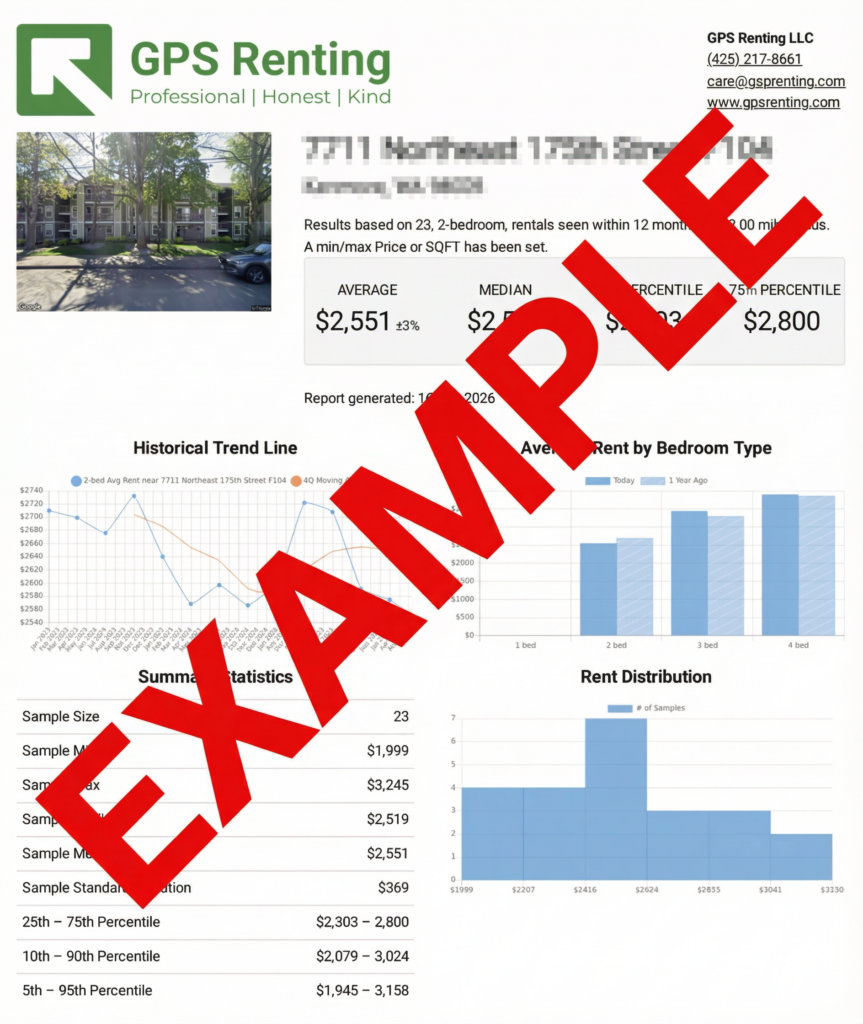
Use our True Cost Calculator to understand your property’s value and rental potential. Input your address and see:
- What your property is worth today
- What you’d net if you sold
- What you’d earn if you kept it as a rental
- How your neighborhood compares
Investor Guide: How to Win in This Market
1. Price at Market, Not Above
Overpricing is the most common and costly mistake in 2026.
Even small mispricing can lead to:
- 20 to 30 extra days vacant
- Thousands in lost rental income
Learn more about how to accurately price your rental in today’s Seattle market
2. Track Leasing Performance
Monitor:
- Views
- Inquiries
- Tours
- Applications
These metrics reveal whether pricing or marketing needs adjustment.
If your property isn’t generating enough inquiries, read why your rental may not be getting applications.
3. Expect More Negotiation
Renters now have more leverage, especially in apartment-heavy segments.
4. Reduce Vacancy Through Better Execution
Well-priced, well-presented properties will still lease efficiently.
5. Use Current Data, Not Past Assumptions
The Seattle market has shifted from fast-paced to competitive.
Need Help Navigating This Market?
Schedule a Consultation
Market shifts can make pricing, leasing, and tenant placement more complex than expected.
If you’d rather focus on your investment while professionals handle pricing strategy, marketing, and tenant screening, we’re here to help.

Haobang Lu
Business Development Manager
Forecast: What to Expect Next
Based on current trends:
- Apartment rents → flat or slightly declining
- Single-family rents → modest growth or stable
- Vacancy → slightly increasing in some segments
- Competition → rising
Seattle remains a strong rental market, but success now depends on pricing strategy and execution rather than momentum.
You can also compare trends across nearby cities like Bellevue in this Bellevue rental market analysis.
FAQs
What is happening in the Seattle rental market in May 2026?
The market is stabilizing, with slower rent growth, increased inventory, and more renter flexibility, especially in apartment segments.
Are rents going down in Seattle in 2026?
Apartment rents have declined slightly, while single-family home rents have remained more stable depending on location and condition.
How much is rent in Seattle right now?
Average apartment rent is around $2,092 per month, while single-family homes typically rent for significantly more depending on size and location.
How long does it take to rent a property?
Most rentals take 20 to 45 days depending on pricing, condition, and location.
Is Seattle still a strong rental market?
Yes, but it is now more balanced and competitive.
What is the rent cap for 2026?
9.683% with a minimum 90-day notice requirement.
Data Transparency
Rental data may vary by property type, listing platform, and timing. The figures above reflect aggregated averages from multiple sources and should be used as directional benchmarks rather than exact pricing.
Sources

Written by Nick He, Founder of GPS Renting
Nick He founded GPS Renting with the mission of delivering professional, honest, and kind property management across the Greater Seattle area. With deep expertise in regional rental trends, market analytics, and Washington housing regulations, Nick provides data-driven insights that help landlords and investors make informed decisions in one of the most complex rental markets in the country. His monthly market updates are trusted by Seattle-area owners who rely on accurate forecasting, clear analysis, and grounded operational experience to stay ahead of market shifts.