

Managing a rental property in Redmond, Washington can become more expensive than expected once you account for vacancy, maintenance, tenant turnover, leasing, compliance, and the time required to manage day-to-day issues.
That is why many owners begin their search with one question:
How do I find affordable property management in Redmond, WA?
The better question is not simply which property manager charges the lowest percentage. It is which management system helps you protect rental income while controlling avoidable costs.
Quick Answer
Affordable property management in Redmond should be measured by total rental performance, not just the monthly management fee.
A lower management fee can save money upfront, but those savings may disappear if the property experiences longer vacancy, poor tenant placement, unexpected fees, delayed maintenance, or frequent turnover.
For most landlords, the more useful comparison is:
Management cost + vacancy + turnover + maintenance + leasing costs + owner time = true cost of property management.
Key Takeaway
The cheapest property management company is not necessarily the most affordable.
A cost-effective property manager should help you:
- Price the rental accurately
- Market the property effectively
- Screen applicants consistently
- Reduce avoidable vacancy
- Coordinate maintenance efficiently
- Communicate clearly with owners
- Follow applicable Washington landlord-tenant requirements
- Provide transparent financial reporting
The goal is not simply to lower the management fee. It is to improve the property’s overall performance.
On This Page
- What affordable property management really means
- The true cost of property management
- Why vacancy matters so much
- Tenant screening and turnover
- Maintenance costs
- Hidden management fees
- How to compare Redmond property managers
- When self-management makes sense
- Redmond and Eastside rental market considerations
- Questions to ask before hiring a property manager
- Frequently asked questions
What Does "Affordable Property Management" Really Mean?
When landlords compare property management companies, the monthly fee is usually the easiest number to compare.
But it is only one part of the cost.
A property manager charging a lower percentage may appear less expensive. However, if the property remains vacant longer or requires more owner involvement, the actual savings can quickly disappear.
For example, landlords should consider:
| Cost Area | Why It Matters |
|---|---|
| Management fee | The recurring cost of professional management |
| Vacancy | Every vacant day represents lost rental income |
| Tenant placement | Leasing fees can significantly affect first-year costs |
| Turnover | Cleaning, repairs, marketing, and lost rent can add up |
| Maintenance | Delayed repairs may become larger repairs |
| Renewals | Some managers charge separately for lease renewals |
| Owner time | Self-managing problems still has a real time cost |
| Compliance | Mistakes involving notices, deposits, leases, or repairs may create additional risk |
A useful property management comparison should consider all of these costs together.
How Do You Calculate the True Cost of Property Management?
A simple way to think about the true cost is:
Management fees + leasing costs + vacancy losses + turnover costs + maintenance inefficiencies + owner time
This produces a more realistic picture than comparing management percentages alone.
For example, imagine two management companies.
Company A
- Lower monthly management fee
- Property takes longer to lease
- Additional leasing and renewal fees
- Limited marketing
- More owner involvement
Company B
- Slightly higher monthly fee
- Stronger leasing process
- Faster communication
- Better reporting
- More structured maintenance coordination
Company A may appear cheaper when comparing only the monthly percentage.
Company B may ultimately cost less if it prevents even a few additional weeks of vacancy or reduces unnecessary turnover.
That is why landlords should evaluate net rental performance, not simply the advertised fee.
Vacancy Can Cost More Than the Management Fee
Vacancy is one of the largest expenses rental owners can experience.
Consider a Redmond rental priced at $3,000 per month.
That is approximately:
- $100 in rental income per day
- $700 per week
- $3,000 per month
An additional three weeks of vacancy could represent roughly $2,100 in lost gross rent.
That loss can easily be greater than the difference between two property management fee structures.
Vacancy is affected by several factors:
- Asking rent
- Seasonality
- Property condition
- Photography
- Listing quality
- Market exposure
- Showing availability
- Applicant responsiveness
- Competing rental inventory
If your property has been listed but is receiving very few applications, review our guide on why your rental isn’t getting applications.
You can also read our guide to diagnosing an underperforming rental property.
Want to Know What Vacancy Could Be Costing You?
A rental analysis can help you compare your current asking rent with market conditions and identify potential pricing or positioning problems.
Tenant Screening Can Affect Long-Term Costs
Placing a tenant quickly matters, but placing the right tenant matters too.
A consistent screening process can help property owners evaluate applicants using established qualification standards rather than making rushed decisions simply to end a vacancy.
Poor tenant placement may contribute to:
- Missed rent
- Lease violations
- Property damage
- Frequent owner involvement
- Early turnover
- Additional leasing costs
Landlords should ask prospective property managers how their screening process works and how qualification standards are applied.
Screening practices also need to follow applicable federal, Washington State, and local requirements.
The Washington State Attorney General’s landlord and tenant resources provide information for Washington rental housing participants.
Landlords can also review Washington’s Residential Landlord-Tenant Act, RCW 59.18.
These resources should not replace legal advice when a specific legal issue arises, but they are useful authoritative references.
Maintenance Is Another Part of Affordability
Property maintenance is unavoidable.
The difference is how effectively maintenance problems are identified, communicated, and resolved.
Poor maintenance coordination can contribute to:
- Longer repair times
- Tenant frustration
- Repeat service calls
- More expensive repairs
- Additional owner involvement
- Higher turnover
For example, a small water issue that is addressed quickly may require a relatively simple repair.
The same problem left unresolved may eventually affect flooring, drywall, cabinetry, or neighboring areas.
Good property management is not necessarily about choosing the cheapest repair. It is about handling problems efficiently enough to prevent avoidable escalation.
Washington landlords should also understand applicable repair obligations and response requirements.
You can learn more in our guide to Seattle and Washington maintenance timelines.
Ready to Understand Your Property’s Value?
When comparing Redmond property management companies, ask for the complete fee structure.
Possible charges may include:
- Monthly management fees
- Tenant placement fees
- Lease renewal fees
- Setup fees
- Inspection fees
- Maintenance coordination fees
- Vacancy fees
- Advertising fees
- Early termination fees
A company advertising a low monthly percentage may not necessarily have the lowest overall cost.
Ask This Question
Instead of asking:
“What percentage do you charge?”
Ask:
“What would my total expected management and leasing costs look like during a normal 12-month period?”
That question makes it easier to compare different pricing models.
Stay Informed About the Seattle Rental Market
Staying informed about the Seattle rental market allows property owners to make smarter, data-driven decisions. We share regular updates, local Seattle insights, and market analysis to help landlords navigate pricing trends, demand changes, and new regulations.
Affordable vs. Cheap Property Management
These terms sound similar, but they are not necessarily the same.
| Cheap Property Management | Cost-Effective Property Management |
|---|---|
| Focuses mainly on lowering the advertised fee | Focuses on overall rental performance |
| May reduce included services | Clearly explains what is included |
| May charge additional fees separately | Makes the total fee structure easier to understand |
| May provide limited marketing | Uses a structured leasing strategy |
| May rely heavily on owner involvement | Handles routine management systematically |
| Measures savings by fee | Measures value by net results |
A landlord should not automatically reject a low-cost provider.
The important question is whether the lower cost comes from operational efficiency or from reducing services that affect rental performance.
How Should Redmond Landlords Compare Property Managers?
Use the same criteria for every company you interview.
1. Pricing Strategy
Ask how the company determines the initial rental price.
A good answer should involve more than a citywide average. Property type, location, condition, bedroom count, parking, laundry, amenities, seasonality, and competing listings can all matter.
2. Marketing
Ask where the rental will be advertised and how listings are presented.
Photography, property descriptions, syndication, showing availability, and follow-up can influence leasing performance.
3. Tenant Screening
Understand:
- Qualification criteria
- Income verification
- Rental history review
- Credit standards
- Application processing
- Fair housing procedures
4. Vacancy Management
Ask what happens when a property receives inquiries but no applications.
A property manager should have a process for reviewing price, listing presentation, competition, and applicant feedback.
5. Maintenance
Ask:
- How maintenance requests are submitted
- How emergencies are handled
- How vendors are selected
- When owners are contacted
- How repair approvals work
- Whether invoices are documented
6. Communication
Find out how frequently owners receive updates and what situations trigger direct contact.
7. Financial Reporting
Owners should be able to clearly see:
- Rent collected
- Management charges
- Maintenance expenses
- Owner distributions
- Property-level financial activity
8. Local Experience
Redmond is part of the Eastside rental market, but a Redmond rental should not automatically be priced the same way as a similar property in Seattle, Bellevue, Kirkland, Bothell, or another nearby market.
Local comparables matter.
Ready to Understand Your Property’s Value?
See how much your rental could earn and make smarter decisions about pricing and tenant placement.
Calculate Your Rental Potential
Use our True Cost Calculator to understand your property’s value and rental potential. Input your address and see:
- What your property is worth today
- What you’d net if you sold
- What you’d earn if you kept it as a rental
- How your neighborhood compares
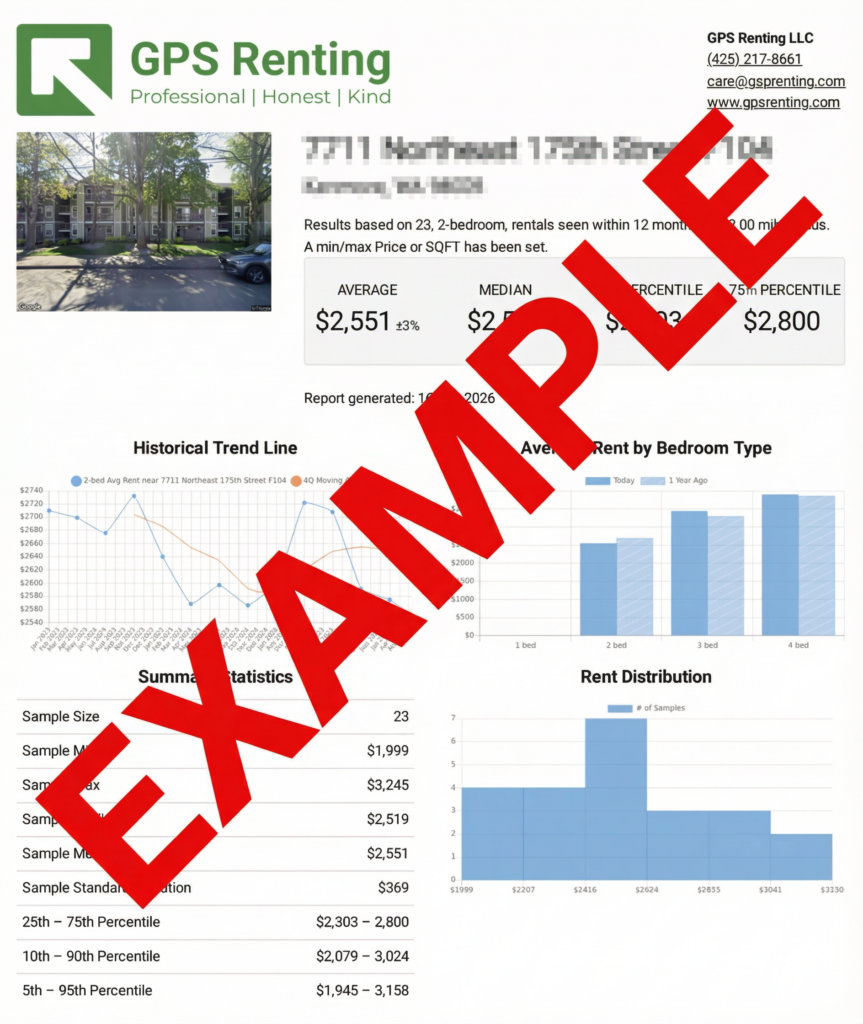
Redmond Rental Pricing Should Be Based on the Property, Not Just the City
One mistake rental owners can make is relying too heavily on broad market averages.
A citywide average cannot tell you exactly what one individual property should rent for.
For a Redmond rental, pricing should consider factors such as:
- Neighborhood
- Property type
- Number of bedrooms and bathrooms
- Square footage
- Parking
- Garage availability
- Laundry
- Heating and cooling
- Property condition
- Outdoor space
- Pet policy
- School-area demand
- Nearby competing rentals
- Current season
This is also why pricing should be reviewed periodically while a property is actively marketed.
A property generating strong inquiries but no applications may have a different problem from a property generating almost no inquiries at all.
Stay Current With the Seattle and Eastside Rental Market
Redmond does not operate separately from the broader Eastside and Greater Seattle rental market.
Changes in rental inventory, seasonality, employment, tenant demand, and competing properties can influence leasing decisions.
GPS Renting publishes regular rental market analysis to help owners understand current conditions.
Read the September 2026 Seattle Rental Market Analysis
Market reports are useful for understanding direction and broader trends, but individual rental pricing should still be based on property-specific comparable rentals.x
Is Self-Managing a Redmond Rental More Affordable?
Sometimes.
A landlord with the time, experience, systems, and local knowledge to manage the property effectively may be able to reduce direct management expenses.
But self-management also requires the owner to handle tasks such as:
- Rental pricing
- Advertising
- Showings
- Applicant communication
- Screening
- Lease administration
- Rent collection
- Maintenance coordination
- Tenant questions
- Documentation
- Renewals
- Move-outs
- Legal and compliance updates
The real comparison should therefore be:
Professional management cost vs. professional management cost + or minus the financial impact of self-management.
For some landlords, self-management works well.
For others, the time commitment and operational risk outweigh the management fee.
Questions to Ask a Property Manager Before Signing
Before hiring a property management company in Redmond, ask:
- What is your complete fee structure?
- What services are included in the monthly management fee?
- Is there a separate tenant placement fee?
- How do you determine rental pricing?
- Where are properties marketed?
- How do you screen applicants?
- How do you handle a property that is not receiving applications?
- How are maintenance requests handled?
- When do you contact the owner before approving repairs?
- How often do owners receive financial reports?
- How do you handle lease renewals and notices?
- What happens if I decide to end management?
- How much owner involvement is normally required?
- What systems do you use to track leasing and maintenance?
- How familiar are you with Redmond and Eastside rental conditions?
A company should be able to answer these questions clearly.
If the fee structure or process is difficult to understand before you sign, it may become even harder to understand after management begins.
Ready to Improve Your Rental Performance?
Schedule a Consultation
If you’re unsure whether your current approach is maximizing your returns, we can walk you through how your property is performing and where improvements can be made.

Haobang Lu
Business Development Manager
A Structured Approach to Redmond Property Management
At GPS Renting, we look at property management as a connected system rather than a collection of individual tasks.
That includes:
- Rental pricing
- Listing preparation
- Marketing
- Showing coordination
- Tenant screening
- Lease administration
- Rent collection
- Maintenance coordination
- Inspections
- Renewal management
- Financial reporting
- Owner communication
Each part can affect the next.
For example, inaccurate pricing can increase vacancy. Longer vacancy can create pressure to accept an applicant too quickly. Poor tenant placement can then increase the risk of turnover or management problems later.
A structured process helps reduce those avoidable problems.
Learn more about our approach to Redmond property management services.
You can also review our property management guarantees to understand the commitments behind our management service.
How Can You Tell if Your Current Rental Is Underperforming?
Possible warning signs include:
- Long periods without qualified applications
- Repeated price reductions
- Frequent tenant turnover
- Higher maintenance costs than expected
- Poor communication with your property manager
- Unexpected management fees
- Rent that appears significantly below or above comparable properties
- Large differences between projected and actual rental income
One warning sign does not automatically mean the property is poorly managed.
However, several of these issues occurring together may justify a closer review.
Our guide to an underperforming rental property explains how owners can review pricing, vacancy, expenses, condition, and leasing performance.
Want to Know How Your Redmond Rental Is Performing?
Before changing property managers or adjusting your rent, it helps to understand the numbers. Our rental analysis can help you review your property’s market position and rental potential.
FAQs
Is affordable property management in Redmond actually worth it?
Affordable property management can be worth it if the service still maintains strong systems for pricing, tenant screening, and maintenance. The risk comes when lower pricing leads to reduced service quality, which can result in longer vacancy, tenant issues, or higher repair costs. In many cases, the overall value depends more on performance than the monthly fee.
What is the difference between cheap and cost-effective property management?
Cheap property management usually focuses on minimizing upfront cost, often by reducing service levels or adding hidden fees. Cost-effective property management, on the other hand, focuses on improving long-term results by reducing vacancy, placing reliable tenants, and maintaining the property properly. The difference is not just price—it’s how well the service protects your income over time.
Why do some property management companies charge lower fees?
Lower fees can be the result of limited services, smaller vendor networks, less marketing exposure, or additional fees charged separately. Some companies operate on a low base price but charge extra for leasing, renewals, or maintenance coordination. It’s important to review the full pricing structure rather than just the advertised rate.
Can low-cost property management lead to higher long-term expenses?
Yes, it can. If a property sits vacant longer, attracts lower-quality tenants, or experiences delayed maintenance, the total cost can increase significantly. Lost rent, turnover costs, and larger repairs often outweigh the savings from lower management fees.
How does vacancy impact the true cost of property management?
Vacancy is one of the biggest hidden costs in rental property ownership. Even a few extra weeks without a tenant can result in thousands of dollars in lost income. A management approach that reduces vacancy time through accurate pricing and effective marketing often provides more value than simply choosing the lowest fee.
What should landlords in Redmond look for beyond price?
Landlords should evaluate how a property manager handles pricing, tenant screening, maintenance coordination, communication, and legal compliance. These factors directly impact rental performance and long-term returns, often more than the management fee itself.
Is self-managing a rental property more affordable?
Self-managing may appear more affordable at first, but it often comes with hidden costs such as time investment, legal risk, vacancy loss, and maintenance inefficiencies. Many landlords find that professional management helps create more consistent income and reduces unexpected expenses over time.
How can I compare property management companies in Redmond?
To compare property management companies effectively, look at their pricing structure, services included, tenant screening process, marketing approach, maintenance system, and communication standards. Asking how they reduce vacancy and handle tenant issues can give better insight than focusing on price alone.
When does it make sense to hire a property manager instead of choosing the lowest-cost option?
It makes sense to hire a property manager when you want to reduce risk, save time, and improve consistency in rental income. A structured management system can help avoid common issues such as tenant disputes, compliance mistakes, and prolonged vacancy, which often cost more than the difference in management fees.
Where can I learn more about full-service property management in Redmond?
If you want to explore a more structured and results-focused approach, you can review Redmond property management services to understand how pricing, tenant placement, and operations work together to improve long-term performance.
Final Thoughts
Affordable property management in Redmond should not be defined by the lowest advertised management fee.
The better question is:
What does it cost to operate the rental successfully over an entire year?
Vacancy, tenant turnover, maintenance, leasing expenses, management fees, and owner time all affect the answer.
A well-managed rental still has expenses. The objective is to reduce avoidable losses, make informed decisions, and create a more predictable ownership experience.
If you are comparing property managers, start with the complete fee structure, then look at the systems behind pricing, leasing, tenant screening, maintenance, and communication.
That will usually tell you much more than the management percentage alone.
Sources and Further Reading
For landlords who want to independently review Washington rental requirements and local market information:
This article provides general information for rental property owners and is not legal or tax advice. Rental housing laws can change, and property-specific circumstances may require professional guidance.

Written by Nick He, Founder of GPS Renting
Nick He founded GPS Renting with the mission of providing professional, honest, and kind property management throughout the Greater Seattle area. Through years of working directly with Seattle landlords and residents, Nick has developed extensive experience handling lease compliance issues, tenant communication challenges, property operations, and Washington landlord-tenant regulations. His landlord and tenant guides are designed to help rental property owners navigate complex situations with practical strategies, clear documentation practices, and real-world operational insight tailored to Seattle’s evolving rental market.
Maximize Your Real Estate Investment
Get a Free Rental Analysis Today!