
How to Reduce Correlated Risk in a High-Cost, Tech-Driven Market
In a market like Seattle — where property values are high and employment is heavily influenced by the technology sector — concentration risk can quietly undermine long-term rental stability.
According to RePEc: Research Papers in Economics, intracity diversification can reduce portfolio income volatility by lowering asset correlation while maintaining expected returns. In simple terms, when assets move together during economic stress, risk compounds. When they move differently, volatility decreases.
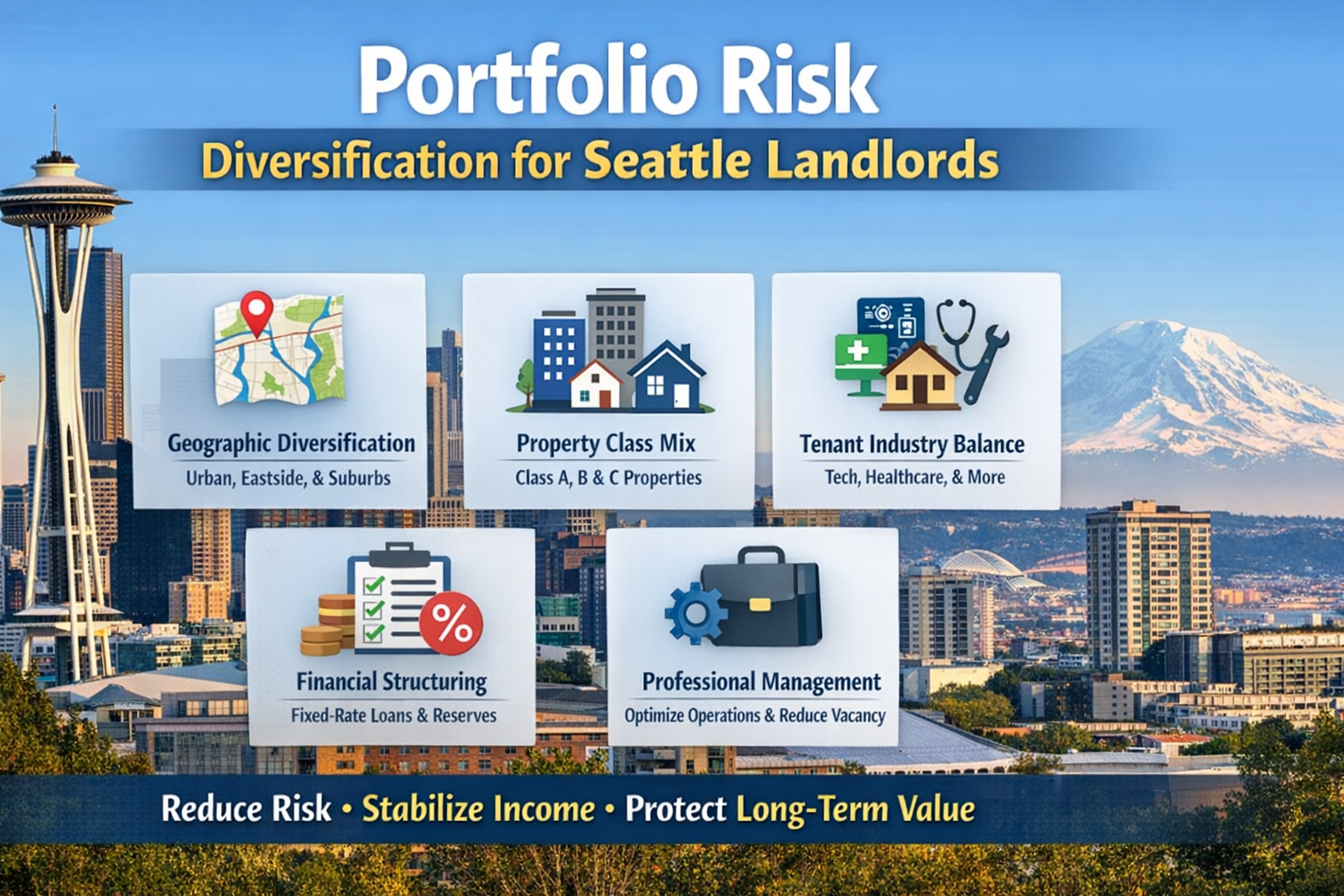
For Seattle landlords, diversification is not about expansion for the sake of scale. It is about structuring exposure across neighborhoods, asset types, tenant industries, and financing structures.
Key Takeaway
In Seattle’s high-cost, tech-driven rental market, owning multiple properties is not the same as owning a diversified portfolio. True resilience comes from strategically spreading risk across neighborhoods, property classes, tenant industries, financing structures, and operational systems. By reducing correlation exposure and strengthening income stability, Seattle landlords can protect cash flow, minimize volatility, and build long-term wealth that withstands economic cycles — not just benefits from them.
1. Expanding Property Variety Beyond Traditional Rentals
A resilient portfolio begins with asset mix.
According to Trinity Real Estate, diversified direct real estate exposure across asset types can produce more stable long-term return trends compared to concentrated holdings.
In the Seattle context, diversification may include:
- Single-family homes
- Small multifamily properties
- Mixed-use building
- Select light commercial assets
- Workforce housing (B and C-class)
While Class A luxury properties often dominate headlines, workforce housing frequently demonstrates more resilient occupancy during economic slowdowns due to necessity-based demand.
According to Rentastic, spreading investments across multiple property categories helps prevent one segment’s downturn from disrupting overall portfolio performance.
2. Geographic and Intracity Strategic Planning
Where you invest in Greater Seattle matters as much as what you buy.
According to Real Property Associates, proactive portfolio management includes diversifying across submarkets influenced by different economic drivers.
Seattle’s urban core is heavily tech-influenced. Submarkets such as Everett operate differently.
According to Smart Real Estate Investment Strategies for Everett, Everett offers growing employment diversity, more affordable entry points compared to Seattle proper, and strong rental demand driven by aerospace and logistics.
Research on intracity diversification, as discussed in RePEc: Research Papers in Economics, suggests that investing across neighborhoods with lower income correlation can significantly reduce portfolio volatility.
In practical terms:
- Downtown Seattle and South Lake Union may move together
- Everett and Lynnwood may respond differently to tech hiring cycles
- School-district-driven suburbs often show different leasing patterns
Intracity diversification is especially powerful in concentrated employment markets like Seattle.
3. Mitigating Tenant Industry Concentration Risk
Tenant concentration risk is commonly discussed in commercial real estate, but the same principles apply to residential portfolios.
According to CoreCast, tenant industry profiles directly influence return stability and concentration risk.
In Seattle, many tenants work in:
- Technology
- Venture-backed startups
- High-growth firms
If layoffs cluster within a dominant sector, vacancy risk can increase simultaneously across multiple properties.
Landlords can reduce this exposure by:
- Diversifying tenant employment industries
- Maintaining conservative rent-to-income ratios
- Staggering lease expiration dates
- Screening for long-term employment stability
4. Choosing the Right Investment Vehicles
Modern real estate investing offers multiple exposure structures.
According to Ark7, technology platforms have lowered barriers to entry through fractional real estate investing.
However, according to FinStrat Management, conservative debt strategy and structured oversight provide more control over value creation and risk mitigation.
In high-cost markets like Seattle, control and operational discipline often matter more than passive exposure.
Landlords may balance diversification through:
- Direct ownership
- Syndications
- Structured partnerships
- Professionally managed portfolios
Each vehicle carries its own risk-return profile.
5. Timing and the Real Estate Cycle
Successful investors understand market cycles.
Real estate typically moves through:
- Recovery
- Expansion
- Hyper-supply
- Recession
During recovery, undervalued assets emerge.
During expansion, growth accelerates.
During supply spikes, liquidity preservation becomes critical.
During recession, disciplined acquisition may present opportunity.
Diversified portfolios adapt more smoothly across these transitions.
Learn how structured management improves portfolio performance: How property management works in seattle
6. Leveraging Technology for Portfolio Monitoring
Diversification must be supported by data.
According to portfolio management insights from Real Property Associates, structured oversight and performance monitoring improve rental income stability.
Professional systems allow landlords to track:
• Occupancy rates
• Renewal percentages
• Expense ratios
• Turnover cycles
• Rental income trends
Data visualization enables faster decision-making and earlier identification of underperformance.
Diversification without monitoring is incomplete.
For current market context: Seattle rental market forecast 2026
Why Diversify Now in Seattle?
Seattle’s risk profile includes:
- High property entry costs
- Tech-sector employment concentration
- Interest rate sensitivity
- Regulatory complexity
According to portfolio risk reduction research, spreading assets across non-correlated segments reduces volatility and enhances income durability.
Diversification is not about building an empire.
It is about engineering resilience.
Conclusion
According to academic research, industry portfolio analysis, and real-world management frameworks, diversified real estate portfolios demonstrate lower volatility and more stable long-term returns.
For Seattle landlords, resilience requires:
- Geographic dispersion
- Asset class balanc
- Tenant industry diversification
- Conservative financial structuring
- Operational discipline
A concentrated portfolio may grow quickly during expansion.
A diversified portfolio survives every cycle.
Frequently Asked Questions
What is portfolio diversification in Seattle real estate?
- Portfolio diversification means spreading rental investments across different neighborhoods, property types, tenant profiles, and financing structures to reduce income volatility in the Seattle market.
Why is diversification especially important in Seattle?
- Seattle’s economy is heavily influenced by the tech sector. Concentrating rental assets in tech-driven neighborhoods increases exposure to layoffs and hiring cycles.
Should Seattle landlords invest outside the city?
- Yes. Expanding into suburbs like Everett, Lynnwood, or Bothell can reduce correlation risk and balance exposure to different employment bases.
Is workforce housing safer than luxury rentals in downturns?
- Workforce housing often maintains steadier demand during economic slowdowns because it serves necessity-based tenants.
How does professional property management support diversification?
- Professional management standardizes operations, reduces vacancy risk, improves pricing strategy, and protects income across a diversified portfolio.
Ready to Stress-Test Your Rental Portfolio?
If you own property in Seattle or the Greater Puget Sound area, diversification should not be guesswork.
Our team at GPS Renting can review your:
- Geographic concentration
- Tenant industry exposure
- Cash flow stability
- Lease renewal timing
- Financing structure
- Operational efficiency
We will identify where your portfolio is overexposed — and where strategic adjustments can improve long-term stability.
Schedule a portfolio strategy call today. GPS renting
Sources
This article references academic research and industry insights from the following publications:
RePEc: Research Papers in Economics – Intracity diversification research examining how lower asset correlation can reduce portfolio income volatility.
Real Property Associates – Proactive Portfolio Management – Geographic diversification and structured real estate portfolio oversight strategies.
Real Property Associates – Smart Investment Strategies in Everett – Submarket expansion and emerging rental market considerations in Greater Seattle.
CoreCast – Tenant Industry Profiles and CRE Returns – Tenant concentration risk and income stability analysis.
FinStrat Management – Unlocking Multifamily Real Estate Success – Conservative debt strategy and risk management frameworks.
Rentastic – Portfolio Diversification Strategies in Real Estate – Practical diversification approaches across property categories.
Ark7 – Real Estate Investing in Washington – Fractional investing platforms and modern access to diversified exposure.
Trinity Real Estate – Why Direct Real Estate – Long-term return stability considerations in direct real estate ownership.