
Spring is here, and with it comes the annual tenant migration. If you own rental property in the Seattle area, this is your busiest season. Tenants are moving, leases are ending, and vacancies need to be filled.
But here’s what’s different about April 2026: The market has slowed.
After a strong start to the year, the rental market is shifting. Properties are staying on the market longer. Vacancy rates are increasing. And landlords who don’t understand this shift could leave money on the table.
Let me walk you through what’s really happening in the April 2026 Seattle rental market, and how to price your property correctly in this new environment.
The Seattle rental market in April 2026 is moving at two different speeds. The 3-bedroom single-family home market remains relatively strong, driven by families and established professionals looking for larger living spaces. But demand has moderated compared to March. Learn more
Here’s what the data shows:
Ready to Explore Your Seattle Rental Potential?
See how your property compares in the April 2026 market.
3-Bedroom Single-Family Homes - April 2026 Market Data
Based on the latest market research from GPS Renting, RentCafe, and Zillow, here’s what 3-bedroom single-family homes are renting for across the Seattle area:
Seattle (Central & Metro)
- Average rent: $3,950/month
- Year-over-year change: +7.2%
- Typical time to fill: 18-25 days
- Tenant profile: Families, established professionals, remote workers
Bellevue
- Average rent: $4,850/month
- Year-over-year change: +5.4%
- Typical time to fill: 15-20 days
- Tenant profile: Tech executives, high-income families, corporate relocations
Read More: Bellevue Rental Market Forecast April 2026
Kirkland
- Average rent: $4,500/month
- Year-over-year change: +4.7%
- Typical time to fill: 22-30 days
- Tenant profile: Tech workers, families, long-term residents valuing community
Read More: Kirkland Rental Market Forecast April 2026
Redmond
- Average rent: $4,600/month
- Year-over-year change: +5.1%
- Typical time to fill: 16-22 days
- Tenant profile: Tech families, dual-income households near Microsoft campus
Bothell
- Average rent: $3,010/month
- Year-over-year change: +2-3% (estimated)
- Typical time to fill: 28-35 days
- Tenant profile: Families, young professionals, tech workers
Read More: Bothell Rental Market Forecast April 2026
Lynnwood
- Average rent: $2,900-$3,010/month
- Year-over-year change: +1.8-2%
- Typical time to fill: 35-45 days
- Tenant profile: Families, working professionals, first-time renters
Sammamish
- Average rent: $3,246/month
- Year-over-year change: +2-3% (estimated)
- Typical time to fill: 30-40 days
- Tenant profile: Families, established professionals, community-oriented
Read More: Sammamish Rental Market Forecast April 2026
Stay Informed About the Seattle Rental Market
Understanding the latest rental trends helps you make confident, data-driven decisions for your property. We regularly share updates, insights, and local market news to keep property owners ahead of the curve.
The April Slowdown: What's Changed?
While February and March 2026 showed strong demand for single-family homes, the rental market has noticeably slowed in April. Here’s what landlords are experiencing:
Days on Market: Properties are now staying on the market 30-45 days on average, up from 15-25 days in February-March. This is a significant shift that affects your pricing strategy. Learn more
Vacancy Rates: Increasing across all neighborhoods. The tight market of early 2026 is loosening as new inventory comes online and tenant demand normalizes after the peak winter leasing season. Redfin market trends
Tenant Behavior: Renters are being more selective. They’re comparing more options. They’re negotiating harder. The power dynamic has shifted slightly from landlord-favorable to more balanced.
Market Trend: This is a typical spring transition. After the peak winter leasing season (January-March), the market always softens in April-May. It’s not a crash. It’s a normalization.
Why the Slowdown Matters for Your Pricing
This slowdown changes your pricing strategy significantly. Here’s why:
In February-March: You could price slightly above market rate and still fill quickly because demand was strong.
In April: You need to price at or slightly below market rate to fill your vacancy in a reasonable timeframe. Learn more
The Math:
Let’s say you own a 3-bedroom single-family home in Bellevue. The market rate is $4,850/month.
If you price at $5,100/month (above market):
- Your property sits for 40-50 days instead of 15-20 days
- You lose 20-35 days of rental income: $3,200-$5,600 in lost rent
- You may need to offer concessions (free month, reduced deposit) to fill it
- Total cost: $4,000-$7,000+
If you price at $4,850/month (at market):
- Your property fills in 20-30 days
- You attract quality tenants
- You avoid concessions
- You build a stable, long-term lease
The lesson: In a slowing market, pricing at market rate is smarter than pricing above it. Learn more
Seattle Rents Are Shifting This April
See where your property fits in today’s market.
Neighborhood Pricing Strategy
The data shows clear pricing tiers across the Seattle area:
Premium Markets (Highest Rents):
- Bellevue: $4,850 (highest demand, fastest fill time)
- Redmond: $4,600 (tech hub, strong demand)
- Kirkland: $4,500 (waterfront appeal, community-oriented)
Mid-Range Markets:
- Seattle: $3,950 (urban lifestyle, walkability)
- Sammamish: $3,246 (family-friendly, established community)
Value Markets (More Affordable):
- Bothell: $3,010 (suburban, family-friendly)
- Lynnwood: $2,900-$3,010 (most affordable, longer fill times)
Key Insight: The closer your property is to tech job centers (Bellevue, Redmond), the higher the rent and the faster it fills. The more affordable your neighborhood, the longer it may take, but you’ll have more tenant options.
Tenant Quality Varies by Price Point
Here’s something many landlords don’t realize: cheaper doesn’t always mean more tenants. It often means lower-quality tenants.
When you underprice, you attract price-sensitive tenants who may be more likely to:
- Miss rent payments
- Cause maintenance issues
- Break leases early
- Be harder to evict if problems arise
When you price at market rate, you attract tenants who:
- Have stable income
- Can afford the rent comfortably
- Are less likely to default
- Are more likely to renew their lease
The lesson: Pricing correctly isn’t just about maximizing income. It’s about attracting quality tenants.
Are You Pricing Your Seattle Rental Correctly?
Compare your property with current April 2026 listings.
The Spring Turnover Timeline
Understanding the timeline helps you plan ahead:
Early April: Peak moving season continues, but demand is softer than March. Properties are taking longer to fill.
Mid-April: Slowdown continues. Many leases start May 1st, so the market is still active, but competition is increasing.
Late April: Vacancy rates are highest. Properties that haven’t filled by now may need rent concessions or pricing adjustments. Learn more
May 1st: The major move-in date. Most leases start May 1st. After this, the market typically slows significantly.
Action: If you have a vacancy, list it in early April and price competitively. Don’t wait until late April or you’ll face a much slower market.
What This Means for Your Rental Strategy
If you’re pricing your vacancy right now:
- Use the neighborhood data above as your baseline
- Add or subtract based on your property’s condition, amenities, and location
- Price at market rate, not above or below
- Expect to fill within 20-45 days depending on neighborhood and price
If you’re considering raising rent on an existing tenant:
- Spring is still a good time (lease renewals are common)
- Stay compliant with EHB 1217 (90-day notice required)
- Raise rent modestly (2-3%) to keep quality tenants
- Remember: A good tenant is worth more than a 5% rent increase
If you’re wondering whether to sell or hold:
- Strong rental demand for single-family homes is a good sign
- Your property is generating income
- Market recovery takes time
- Holding often makes more financial sense than selling
The Bottom Line
April 2026 is a more balanced rental market than February-March. Properties are taking longer to fill. Vacancy rates are increasing. But this doesn’t mean the market is broken, it just means it’s normalizing.
The key is understanding that the market has shifted, and your pricing strategy needs to shift with it.
Price at market rate. Fill your vacancy in 20-45 days. Attract quality tenants. Build long-term wealth through rental income.
Don’t overprice and don’t underprice. Price smart. That’s how you win in April 2026.
Ready to Price Your Rental Correctly?
Calculate Your Rental Potential
Use our True Cost Calculator to understand your property’s value and rental potential. Input your address and see:
- What your property is worth today
- What you’d net if you sold
- What you’d earn if you kept it as a rental
- How your neighborhood compares
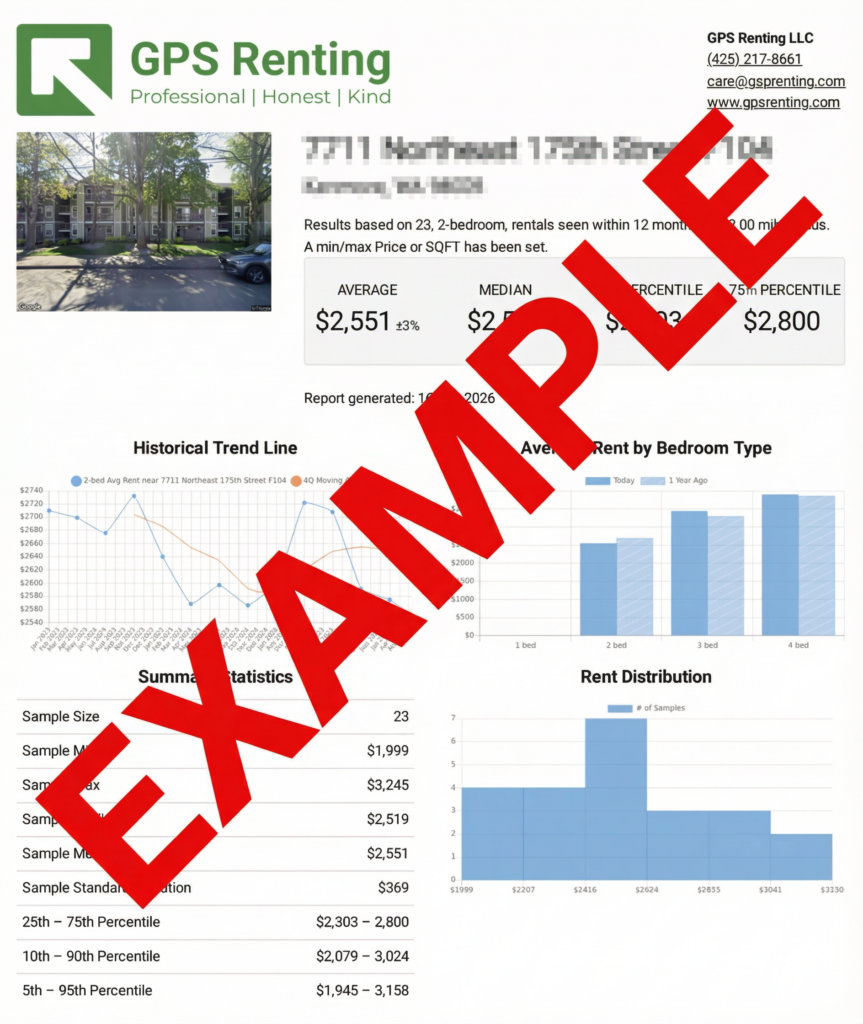
Where Tenants Are Moving in April 2026 (And Why It Matters)
In April 2026, tenant movement across the Seattle area is shifting toward suburban markets that offer more space, better schools, and relative affordability compared to core urban neighborhoods.
Areas such as Bellevue, Redmond, and Kirkland continue attracting high-income renters due to proximity to major tech employers and strong neighborhood amenities.
Meanwhile, cities like Bothell and Lynnwood are seeing increased interest from families and price-conscious tenants seeking larger homes at more accessible rent levels.
Sammamish remains attractive for long-term renters prioritizing community and school districts.
This migration pattern matters for landlords because it directly affects pricing strategy and vacancy timelines.
Properties located near employment centers and in family-oriented suburbs tend to lease faster, while more affordable markets may experience longer days on market but broader tenant pools.
Understanding where tenants are moving helps landlords position their rental competitively and avoid overpricing in areas where demand is stabilizing.
Need Help Managing Your Rental?
Schedule a Consultation
Spring turnover can be stressful. If you’d rather focus on other things while we handle tenant screening, pricing, and lease management, we’re here to help.

Haobang Lu
Business Development Manager
FAQs
Where are tenants moving in the Seattle area in April 2026?
In April 2026, many tenants are moving toward suburban and tech-adjacent cities such as Bellevue, Redmond, and Kirkland due to proximity to major employers and strong neighborhood amenities. These areas typically attract higher-income renters and lease faster. At the same time, families and more budget-conscious tenants are increasingly choosing Bothell, Lynnwood, and Sammamish, where renters can find larger homes at relatively more affordable prices. This migration pattern affects how quickly properties lease and highlights the importance of pricing based on neighborhood demand.
What is happening in the Seattle rental market in April 2026?
The Seattle rental market in April 2026 is shifting to a more balanced environment. Properties are staying on the market longer, vacancy rates are increasing slightly, and tenants are becoming more selective. While demand for 3-bedroom single-family homes remains strong, landlords must price more carefully to avoid extended vacancy periods.
Are rents still increasing in Seattle in April 2026?
Yes, rents are still increasing year over year in many Seattle-area cities such as Bellevue, Redmond, and Kirkland. However, the pace of growth has slowed compared to early 2026. This means landlords may not be able to price aggressively above market and should instead focus on competitive pricing.
How long does it take to rent a home in Seattle right now?
In April 2026, most single-family homes in the Seattle area are taking between 20 and 45 days to fill depending on location, pricing, and condition. Premium markets like Bellevue and Redmond may fill faster, while more affordable areas such as Lynnwood and Bothell may take longer.
Should landlords lower rent in April 2026?
Landlords should not automatically lower rent, but they should price at current market levels. Overpricing can lead to extended vacancy losses, which often cost more than a small rent adjustment. Correct pricing helps attract qualified tenants faster and improves long-term returns.
Which Seattle suburbs have the strongest rental demand?
Bellevue, Redmond, and Kirkland continue to show strong demand due to proximity to tech employment centers. These areas typically command higher rents and experience shorter vacancy periods compared to more affordable suburbs.
Is April a good time to list a rental in Seattle?
Yes. Early April is still part of the spring leasing season, making it a strong time to list. However, competition increases as the month progresses, so landlords should list early and price competitively to avoid delays.
Should landlords raise rent during spring lease renewals?
Spring can be a good time for modest rent increases, typically around 2 to 3 percent. However, keeping a reliable tenant is often more valuable than maximizing rent. Landlords must also comply with Washington notice requirements such as EHB 1217.
What is the biggest mistake landlords make in a slowing rental market?
The most common mistake is overpricing. Even small pricing errors can result in weeks of vacancy, lost income, and potential concessions. Pricing at market value typically leads to faster leasing and better tenant quality.
Is the Seattle rental market crashing in 2026?
No. The April 2026 market represents normalization rather than a crash. Demand remains stable, especially for single-family homes, but landlords must adjust expectations and pricing strategies.

Written by Nick He, Founder of GPS Renting
Nick He founded GPS Renting with the mission of delivering professional, honest, and kind property management across the Greater Seattle area. With deep expertise in regional rental trends, market analytics, and Washington housing regulations, Nick provides data-driven insights that help landlords and investors make informed decisions in one of the most complex rental markets in the country. His monthly market updates are trusted by Seattle-area owners who rely on accurate forecasting, clear analysis, and grounded operational experience to stay ahead of market shifts.